

How Does Foreclosure Work in Arizona?
Most Arizona home loans are secured by a deed of trust. A deed of trust names a neutral trustee and gives that trustee the power to sell the home if the loan goes into default. Because of that power of sale, lenders in Arizona almost always foreclose outside of court through a trustee sale, which is faster and cheaper for them than a lawsuit.
Judicial foreclosure exists, but it is uncommon for homes. A lender can file a foreclosure lawsuit, and some older mortgages require it, but the overwhelming majority of Arizona homeowners who fall behind will deal with the trustee sale process described below.
How Long Does Foreclosure Take in Arizona?
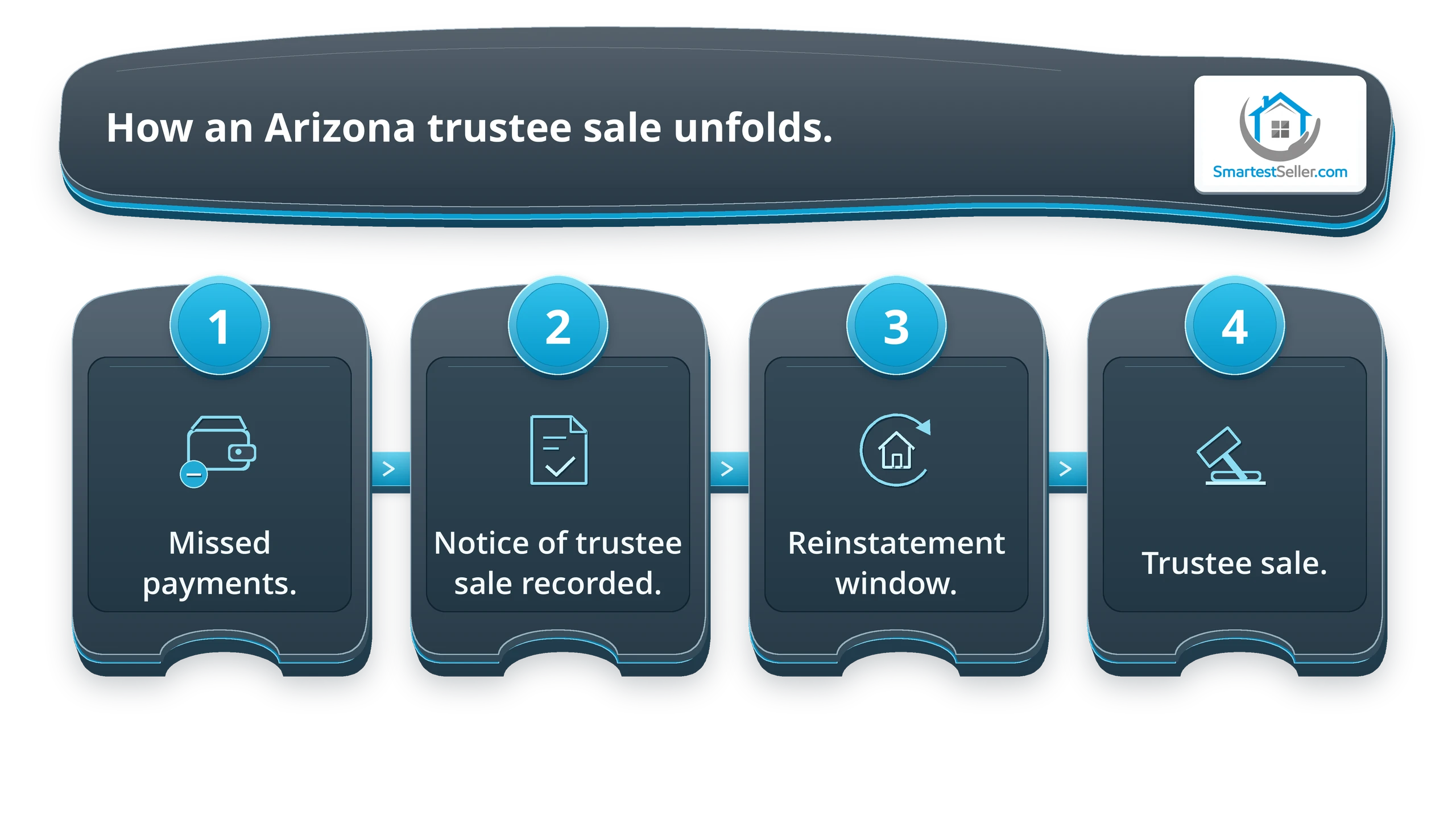
The clock that matters starts when the notice of trustee’s sale is recorded. After a few missed payments, the lender or its servicer typically sends default and breach letters. If the loan is not brought current, the trustee records a notice of trustee’s sale with the county recorder and mails, posts, and publishes it. A.R.S. § 33-808 sets the notice requirements and the minimum period that must pass between recording the notice and holding the sale.
The sale itself is a public auction. The property goes to the highest bidder, which is often the lender. Arizona does not give homeowners a right to buy the home back after a completed trustee sale, so the days before the sale are when every option is still open. After the sale, the new owner can file an eviction case if the home is still occupied.
Will I Be Served Court Papers in an Arizona Foreclosure?
Usually not. Because most Arizona foreclosures are trustee sales, there is no lawsuit and no process server. Instead, you receive the notice of trustee’s sale by mail, it is posted on the property, and it is published in a newspaper. If you are ever served with an actual summons, that means the lender filed a judicial foreclosure or another lawsuit, and you should speak with an Arizona attorney right away because court deadlines are short.
Can I Stop a Foreclosure in Arizona?
Often, yes, if you act before the sale. The main paths are:
Reinstatement. Arizona law generally lets you reinstate the loan by paying the past-due amount plus allowable fees and costs up until shortly before the sale. Ask your servicer for a written reinstatement quote.
Loan modification, forbearance, or a repayment plan. Your servicer may be able to change the loan terms or spread out the missed payments. A HUD-approved housing counseling agency can help you apply at no cost.
Bankruptcy. Filing for bankruptcy generally pauses a trustee sale, but it has long-term consequences. Talk to a bankruptcy attorney before going this route.
Selling the house. If keeping the home is not realistic, selling before the sale date lets you pay off the loan through escrow and keep any remaining equity, instead of losing it at auction.
Can I Sell My House Before the Trustee Sale in Arizona?
Yes, and it is often the best way to protect your equity. A sale closes through a title and escrow company, which gets a payoff figure from your lender, pays the loan and any liens from the proceeds, and has the trustee sale cancelled once the loan is paid. Whatever is left after the payoff goes to you.
Time is the main constraint. A listed sale has to find a buyer, get through financing and an appraisal, and close before the sale date. A direct cash sale does not depend on a buyer’s loan, so it can usually close inside the window as long as the title company can get payoffs in time. If a sale is close but the date is tight, the lender will sometimes postpone the sale when there is a signed contract, though that is up to the lender.
Deed in Lieu vs. Short Sale vs. Selling: What Is the Difference?
| Option | Your equity | Credit impact | Timing | Usually fits |
|---|---|---|---|---|
| Sell the house before the sale | Usually you do, after the loan and liens are paid | Avoids a foreclosure on your record | You choose, as fast as title allows | Homeowners with equity, or any owner who wants control of the timeline |
| Short sale | Lender takes less than it is owed; you usually keep nothing | Damaged, but often less than a completed foreclosure | Slow, because the lender must approve the buyer and price | Owners who owe more than the home is worth |
| Deed in lieu of foreclosure | Lender takes the deed; you keep nothing | Damaged, but often less than a completed foreclosure | Depends on lender approval | Owners with no equity who want a cleaner exit |
| Trustee sale (foreclosure completes) | Any equity above the debt goes through the sale, not to you directly in most cases | Foreclosure reported | Set by the trustee | No one chooses this; it is what happens when nothing else is done |
A deed in lieu of foreclosure means you sign the home over to the lender and walk away. Lenders usually require you to try selling first, and they generally will not accept one if there are other liens on the property. A short sale means the lender agrees to accept less than the full balance from a buyer. Both are mainly for homeowners who owe more than the home is worth. If you have equity, a regular sale almost always leaves you better off.
Will I Owe Money After a Foreclosure in Arizona?
Often not, but it depends on the property and the loan. Arizona has anti-deficiency protections. Under A.R.S. § 33-814, when a deed of trust is foreclosed by trustee sale on property of two and a half acres or less that is limited to and used as a single one-family or two-family dwelling, the lender generally cannot sue the borrower for the remaining balance. Larger parcels, properties with more units, vacant land, some second loans, and other situations can be treated differently, and the rules have changed over time.
Taxes are a separate question. Debt that a lender forgives in a short sale, deed in lieu, or foreclosure can sometimes be treated as income for tax purposes. This section is general information, not legal or tax advice. If you have questions about your own situation, please speak with an Arizona real estate attorney and a tax professional.
How Does Foreclosure Affect My Credit?
A completed foreclosure stays on your credit reports for up to seven years under federal credit reporting rules, and it can make it harder to buy or rent for a while. Late payments that happened before a sale will still show, but selling the home before the trustee sale keeps a foreclosure itself off your record, which is one reason acting early matters.
How Has This Worked for Arizona Homeowners?
Prescott: facing foreclosure
A Prescott homeowner came to us with a trustee sale already on the calendar and no clear plan for where she would go next. We worked with the title company to clear an old recorded loan and closed through a remote notary before the sale date. Then we went further. We connected her with a local agent to find her next home, and let her stay in the house after she was paid so she could move without rushing. We stayed with her through the whole transition, until she was settled in her new home.
Coolidge: behind on payments
This Coolidge homeowner had fallen two months behind on her mortgage and wanted to sell before it turned into a foreclosure. The house needed some repairs, which we took on as-is. She was going through a hard stretch, so every time we visited the house we brought her a meal, and we helped with her living expenses while the sale closed. After closing, we gave her two weeks in the home so she could move out on a manageable schedule instead of the day she signed.
What Should I Do Right Now If I Am Behind on Payments?
1. Open every letter from your lender and the trustee. They contain your deadlines and the sale date. 2. Confirm whether a notice of trustee’s sale has been recorded. In Maricopa County you can search recorded documents on your property through the County Recorder. 3. Call your servicer and ask for a reinstatement quote and your loss mitigation options in writing. 4. Get free help from a HUD-approved housing counselor, and talk to an attorney if you have been served with court papers or are considering bankruptcy. 5. Know what your house would bring on a cash sale and on the open market, so you can compare every option before the sale date.
Our goal is to understand your goal and align with it. If keeping the house is realistic, we will point you toward the people who can help you do that. If selling makes more sense, we can show you what a cash sale, a renovation-backed sale, or a listing would look like. Compare all three options.
Where Do You Help Arizona Homeowners Facing Foreclosure?
We work with homeowners across Arizona, including Phoenix, Mesa, Scottsdale, Glendale, Peoria, Tempe, Chandler, Gilbert, Prescott, and Tucson. Read our full guide to selling a house in Arizona.
Ready to See Your Options?
Tell us about the house and your sale date below, or call (602) 428-9339. Know your selling options. Be the Smartest Seller.
One More Step to Get Your Cash Offer…
Please tell us where to send your offer.