
We are not attorneys and nothing here is legal advice. Divorce property questions should go to your family law attorney, and the explanations below are general background to help you understand the conversation, not a substitute for it.
Who Gets the House in an Arizona Divorce?
Usually neither spouse keeps it outright, because few people can afford it alone. Arizona is a community property state. Under A.R.S. 25-211, property acquired by either spouse during the marriage is presumed to belong to both of you equally, and under A.R.S. 25-318 the court divides community property equitably when you cannot agree. A home bought before the marriage, or received by one spouse as a gift or inheritance, may be separate property under A.R.S. 25-213, though payments made during the marriage can complicate that.
Equitable in Arizona usually means roughly equal, but it is the overall settlement that gets balanced, not each individual asset. One spouse might keep the house while the other takes more of the retirement accounts.
What Are Our Options for the House?
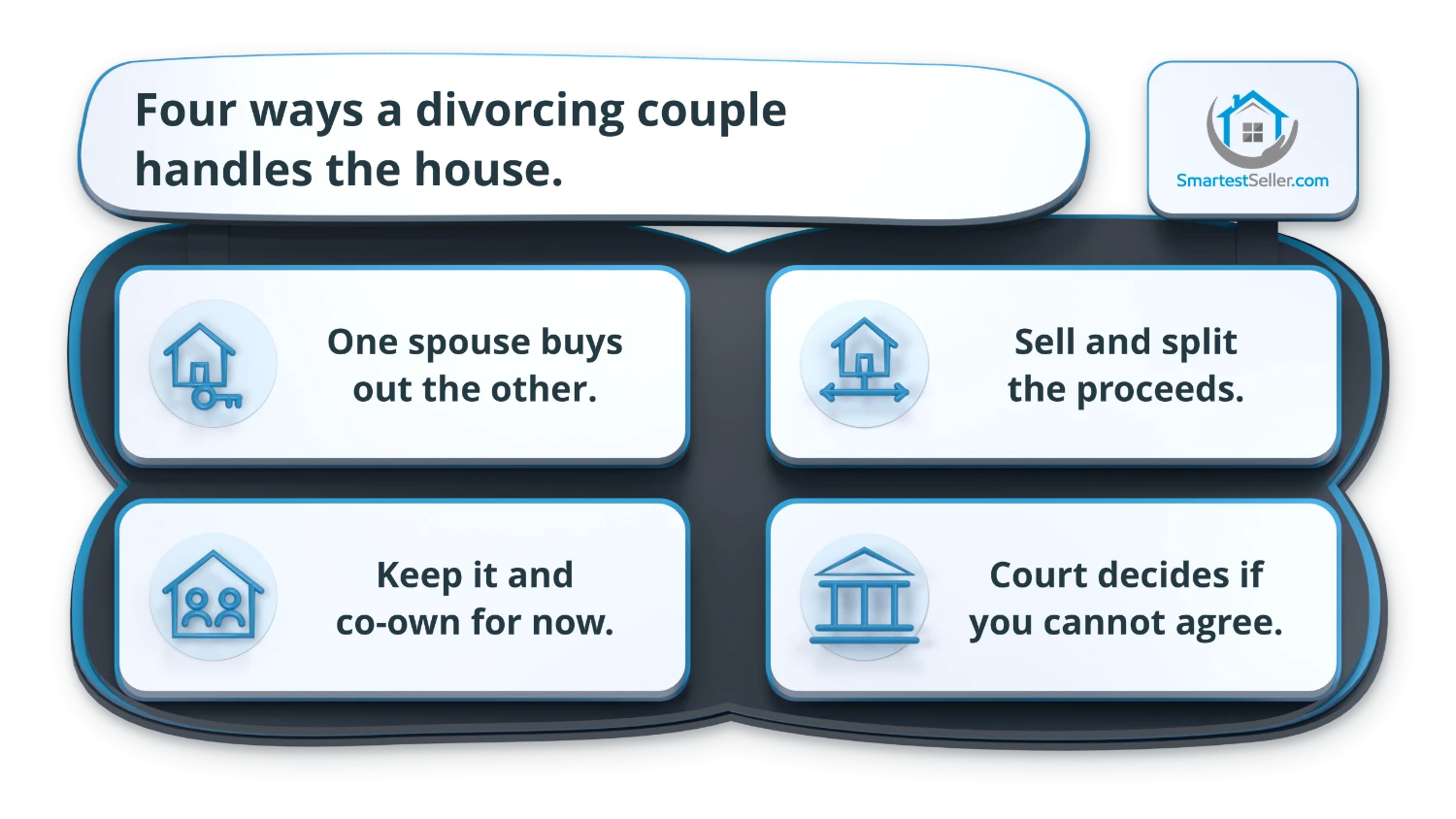
One spouse buys out the other
Works when one of you wants to stay and can qualify alone. You agree on a value, the staying spouse refinances into their own name, and the other receives their share of the equity and signs a deed transferring their interest. The obstacle is almost always the refinance: the staying spouse has to qualify for the full loan on one income, and today’s rates may be well above the existing loan. If the refinance fails, the buyout fails.
Sell and divide the proceeds
The cleanest resolution, and the most common. The house sells, the mortgage and costs come out of escrow, and the net proceeds are divided according to your agreement or the court’s order. Neither of you stays tied to a loan with the other’s name on it. Escrow can be instructed to send each spouse’s share to separate accounts, so no money passes between you.
Keep it and co-own for now
Sometimes right, often fragile. Couples keep the house so children can finish a school year, or because the market feels wrong. It means continuing to share a mortgage, insurance, taxes, and repair decisions with someone you are divorcing. If you do this, get the arrangement in writing: who pays what, who maintains it, what triggers a sale, and how the price gets set.
Let the court decide
The fallback when nothing else is agreed. A judge can order the home sold and the proceeds split, and may appoint someone to handle the sale. It is slower, costs more in legal fees, and removes your control over timing and price.
Do Both Spouses Have to Sign to Sell?
In most cases yes. Where the home is community property, the title company will require both spouses to sign the deed and the closing documents, even when only one name appears on the loan. Where title is genuinely held as one spouse’s separate property, usually evidenced by a recorded disclaimer deed, one signature may be enough. The title company decides what it will insure, and your attorney should confirm the position before you list or accept an offer.
If one spouse refuses to cooperate, that becomes a matter for your attorney and potentially the court. We cannot buy a house that the title company will not insure, and no legitimate buyer can.
Can We Sell Before the Divorce Is Final?
Yes, and many couples do. Nothing requires a finalized decree to sell jointly owned property, as long as both owners agree and sign. What you should check with your attorney is whether a preliminary injunction is in place. In Arizona, service of a divorce petition typically triggers an order restricting the disposal of community property, which is intended to stop one spouse from selling assets unilaterally. A sale both spouses agree to, with the proceeds handled as the court expects, is normally workable, but your attorney needs to bless it first.
How Do the Proceeds Get Divided?
Through escrow, according to your written instructions. The mortgage payoff, any liens, property taxes, and closing costs come out first. What remains is distributed as you and your attorneys direct, which might be an even split, an uneven split reflecting separate property contributions, or proceeds held in a trust account until the settlement is finalized. Escrow follows written instructions signed by both parties, which removes the need for either of you to trust the other with the money.
What If We Owe More Than the House Is Worth?
Then the debt is part of the settlement too. Arizona divides community debts along with community assets. If the home will not cover its loan, options include bringing cash to closing, negotiating a short sale with the lender, or one spouse keeping the property and the debt. A short sale needs lender approval and both signatures, and it affects both credit records. This is a conversation for your attorney and a lender, early rather than late.
Why Do Divorcing Couples Often Sell Directly?
Because a traditional listing requires ongoing cooperation that may not be there. Listing means agreeing on an agent, a price, repairs, staging, showings, and then on every offer and counteroffer that arrives over the following months. Each of those is another negotiation between two people who are already in a difficult one.
A direct sale compresses that into a single decision. One number, one closing date, no repairs, no showings through a home where one of you may still be living. Our price reflects the condition and the resale risk we take on, so it comes in below what a prepared home would fetch on the market. Where you both have the patience and cooperation for a listing, an agent will usually net more, and we will say so. Compare the three options.
How Do You Handle a Sale Where the Spouses Are Not Speaking?
We work with each of you separately, or only through the attorneys, whichever you prefer. Documents can be signed in different places at different times, including remotely. Nobody has to sit at a table together. If communication runs entirely through counsel, that is fine; we are used to it, and we keep both sides informed equally rather than becoming anyone’s ally.
What About the Children and the Timing?
The closing date can work around your family rather than the other way round. We can close around a school term, around a lease starting on a new place, or later than you might expect if that helps. In some cases a seller can stay in the home after closing while they finish arranging the next step. Tell us the constraint and we will build the timeline around it.
A Note on What We Will Not Do
We will not take sides, advise you on your settlement, or tell you what your house is worth for court purposes. If you need a value for the divorce itself, that calls for an appraisal, and a formal appraisal is a different thing from a purchase offer. We will give you an honest offer and an honest read on your options, and leave the legal strategy to your attorney.
Common Questions
Can one spouse sell the house without the other?
Generally not, where the house is community property. The title company will require both signatures. Where one spouse holds the property as separate property with a recorded disclaimer deed, it may be possible, and your attorney and the title company should confirm.
Does it matter whose name is on the mortgage?
For selling, what matters is who is on title, not who is on the loan. The loan gets paid off at closing regardless. For a buyout, it matters a great deal, because the remaining spouse has to qualify to refinance.
What happens to the house if one spouse moves out?
Moving out does not forfeit an ownership interest. Both spouses generally remain owners, and both remain responsible for the mortgage until it is paid off or refinanced, whoever is living there.
Can we sell while the case is still pending?
Usually yes, with both spouses agreeing and your attorney confirming that the preliminary injunction is satisfied and the proceeds will be handled appropriately.
Where We Can Help
We buy houses across Arizona, including Phoenix, Mesa, Chandler, Gilbert, Tempe, Scottsdale, Glendale, Peoria, Surprise, Maricopa, Prescott, Prescott Valley, and Tucson.
Situations we handle: Foreclosure | Inherited property | Divorce | Rental with tenants | Fire or water damage | Tax liens and violations
Want to Know What the House Would Sell For?
Tell us about the property below, or call or text (602) 428-9339. We will give you a straight answer, and if listing would serve you better we will say so. Know your selling options. Be the Smartest Seller.
One More Step to Get Your Cash Offer…
Please tell us where to send your offer.