

How does selling a house in California actually work?
An escrow holder sits between you and the buyer and does not release anything until both sides have performed. They receive the deposit, order a title search, pay off whatever is recorded against the property, and send the signed deed to the county recorder. The sale is final when the recorder stamps that deed, not when you sign.
The title search is where most California sales get complicated. It turns up anything recorded against the parcel: a deed of trust nobody released, a judgment against someone who shares your last name, a contractor lien, unpaid property taxes, a sewer assessment. Every one of those has to be cleared or paid through escrow before the deed can record. Sellers are routinely surprised by items from decades earlier.
Nothing about that changes because you sell for cash. A direct sale skips showings, lender appraisals and repair negotiations, but the title work and the recording still happen exactly the same way.
What do I have to disclose when I sell a house in California?
If you are selling a home with one to four dwelling units, you generally owe the buyer a written Transfer Disclosure Statement. The California Department of Real Estate states it must be given to a prospective buyer as soon as practicable and before transfer of title. It asks what you actually know about the property, not what an inspector might find.
You also owe a Natural Hazard Disclosure. California requires you to say whether the property sits in any of six mapped areas: a FEMA special flood hazard area, a dam failure inundation area, a very high fire hazard severity zone, a state responsibility area with substantial forest fire risk, an earthquake fault zone, or a seismic hazard zone for ground shaking, liquefaction or landslide. If a reasonable person cannot tell for certain, the DRE guidance is to answer yes unless an expert report says otherwise.
Late delivery gives the buyer a way out. If the disclosure reaches the buyer after the purchase agreement is signed, they can terminate within three days of delivery in person, or five days if it came by mail. That is one reason these forms go out early rather than at the end.
The full rules are in the DRE booklet Disclosures in Real Property Transactions.
Which California sellers are exempt from the disclosure form?
Several of the situations that bring people to us are exempt from the Transfer Disclosure Statement. The DRE lists transfers by a fiduciary administering a decedent estate, a guardianship, a conservatorship or a trust, except where the trustee was a former owner of the property. Foreclosure sales are exempt. So are court ordered transfers, transfers resulting from a divorce or legal separation, transfers between co-owners, transfers to a spouse or a lineal relative, and transfers resulting from a failure to pay taxes.
Exempt from the form is not the same as exempt from honesty. You still cannot conceal a material fact you know about. If you inherited a house and never lived in it, the practical answer is usually that you disclose what little you know and say plainly that you have no personal knowledge of the rest. A buyer who understands that up front is a buyer who does not renegotiate later.
Who holds the money, and who regulates them?
California has two different kinds of escrow holder and they answer to different regulators. An independent escrow company is a licensed escrow, regulated by the California Department of Financial Protection and Innovation under the Escrow Law. The other kind is a controlled escrow, run inside a business that is already regulated elsewhere.
Controlled escrows are the more common ones in a residential sale. According to the DFPI, a controlled escrow owned by a title insurance company answers to the Department of Insurance, one run by a real estate broker answers to the Department of Real Estate, one run by an attorney answers to the State Bar, and ones inside federally chartered banks answer to the Office of the Comptroller of the Currency. The DFPI notes that oversight of controlled escrows varies widely.
It is a fair question to ask any buyer who they intend to use. You can read the DFPI explanation on its escrow consumer information page, and you can look up whether a licensed escrow company is in good standing there.
What does it cost to sell a house in California?
Costs fall into four buckets, and which ones apply depends on how you sell. There is the commission, if an agent is involved. There are escrow and title fees. There is the county documentary transfer tax, and in a number of California cities an additional city transfer tax on top of it. Then there is everything recorded against the property that has to be paid off before the deed can record.
Transfer tax rates are set locally and they change, so we do not publish numbers here. Your county recorder publishes the current county rate and will tell you whether your city adds its own. Several large California cities do, and in those places the city portion can be the larger of the two.
On a cash purchase, Smartest Seller covers the closing costs. That means escrow, title and transfer fees. What it does not cover is what you already owe against the property, because that comes out of the proceeds in any sale, to any buyer.
What if the house needs work, has liens, or has tenants in it?
Condition is not a disqualifier. We buy as-is, which means you do not clean it out, you do not make repairs, and you do not stage anything. Our underwriters weigh the condition as it stands, the condition once repaired, what the repairs would cost, how long we would hold it, the risk involved, and how volatile the local market is.
Liens get handled in escrow, not before it. Sellers often assume they need to clear a judgment or a tax lien before anyone will talk to them. The opposite is usually true. Escrow is built to pay those off out of the proceeds, and the payoff figures have to be ordered during the transaction anyway.
Tenants are a California problem of their own. State law limits when and how a tenancy can end, and many California cities layer their own rules on top. We buy tenant occupied property and we do not ask sellers to deliver a house empty.
How do the three ways to sell compare?
Most companies that buy houses offer one thing: a cash offer. We present three, because the right answer depends on your timeline, the condition of the house, and how much of your equity you are willing to trade for speed and certainty.
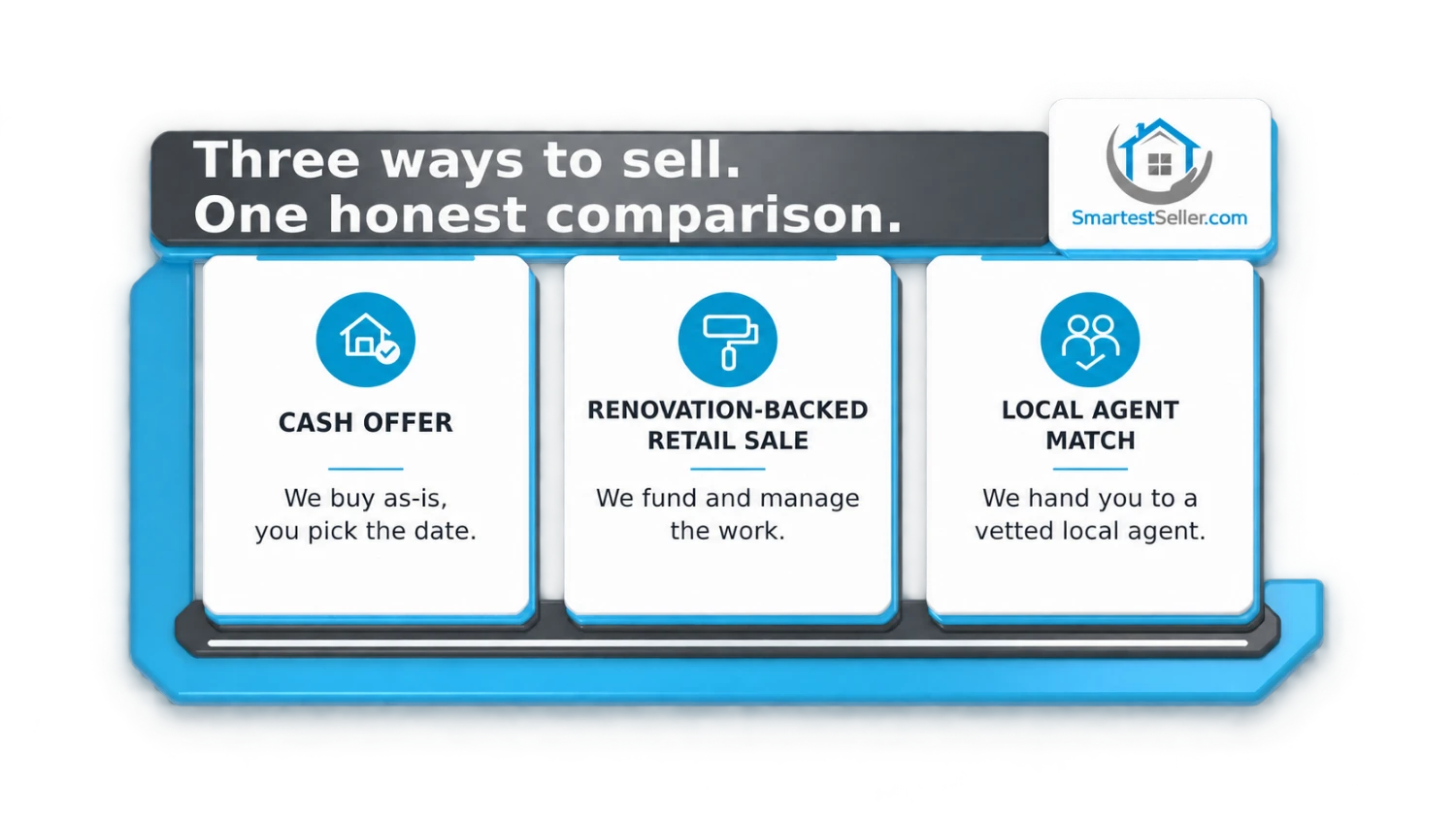
| Question | Cash Offer | Renovation-Backed Retail Sale | Local Agent Match |
|---|---|---|---|
| Who pays for repairs | Nobody, we buy as-is | We manage and pay for them | You do, or you credit the buyer |
| Who pays commission | No commission | We cover it | Paid out of your proceeds |
| Is your price known up front | Yes | Yes | No guarantee of price or net proceeds |
| Who controls the timing | You pick the date | Shared, the work sets some of it | The market and the buyer |
| Best when | Condition, liens or timing make a listing hard | The house has upside but you cannot fund the work | The house is in good shape and you can wait |
We will tell you when listing beats selling to us. If your house is clean, financeable and you have time, a listing will usually net you more, and we would rather say so and keep the relationship than talk you out of it. Know your options. Be the Smartest Seller.
Where does Smartest Seller buy in California?
We buy directly as a principal, not as an agent. Smartest Seller is an Arizona company and we are not acting as real estate brokers in California. When a seller is better served by listing, we hand them off to a licensed local agent rather than keep pushing a purchase.
Our California closings include a single family home on East Lemon Avenue in Lompoc, in Santa Barbara County, and one on Prairie Dunes Drive in Lathrop, in San Joaquin County. We have active files across the Sacramento area, Los Angeles and the San Fernando Valley, the East Bay, and San Diego County, which is where we concentrate.
City pages: Sacramento, Los Angeles, Oakland, San Diego, Riverside, Hemet, Fresno, San Bernardino.
Situations: foreclosure and trustee sale, an inherited house or probate, a tenant occupied property.
Common questions about selling a house in California
Do I have to clean the house out first?
No. Leave whatever you do not want. Sellers routinely hand us keys to a house with furniture and belongings still in it, and we deal with the rest.
What if the house is still in probate?
We buy during probate regularly. A fiduciary administering an estate is exempt from the Transfer Disclosure Statement under California rules, and depending on how the estate is being administered the sale may need court confirmation. See our California inherited house page.
What if there is a tax lien or a code violation?
Both are workable. A recorded lien is paid through escrow out of the proceeds. A code violation is a condition item, which our underwriters account for the same way they account for a roof.
How quickly can this happen?
As fast as the escrow holder and the county can accommodate, at whatever pace you need. Some sellers want it over quickly. Others need to stay in the house while they find the next one, and we schedule around that.
How long does an offer take?
Usually within one business day once we have seen the property details.
Does it cost anything to find out?
No. There is no fee and no obligation, and we are not going to pressure you into a decision on a phone call.
Ready to see what your California house would bring?
Tell us about the property and we will come back to you, usually within one business day, with what we can do and an honest read on whether selling to us is actually your best move.
One More Step to Get Your Cash Offer…
Please tell us where to send your offer.
Where else we buy
Arizona: statewide guide, Phoenix, Scottsdale, Mesa, Tucson. See every market on our Where We Buy page.