Why Will You Not Just Give Me a Percentage?
Because the percentage you see quoted online is a marketing device, not how buying actually works. Two houses on the same street with the same square footage can justify very different offers, because one needs a roof and the other needs a roof, a sewer line, and has an unpermitted addition that has to be resolved. A fixed percentage would mean overpaying for the difficult house and underpaying for the easy one. We would rather do the work and show you the reasoning.
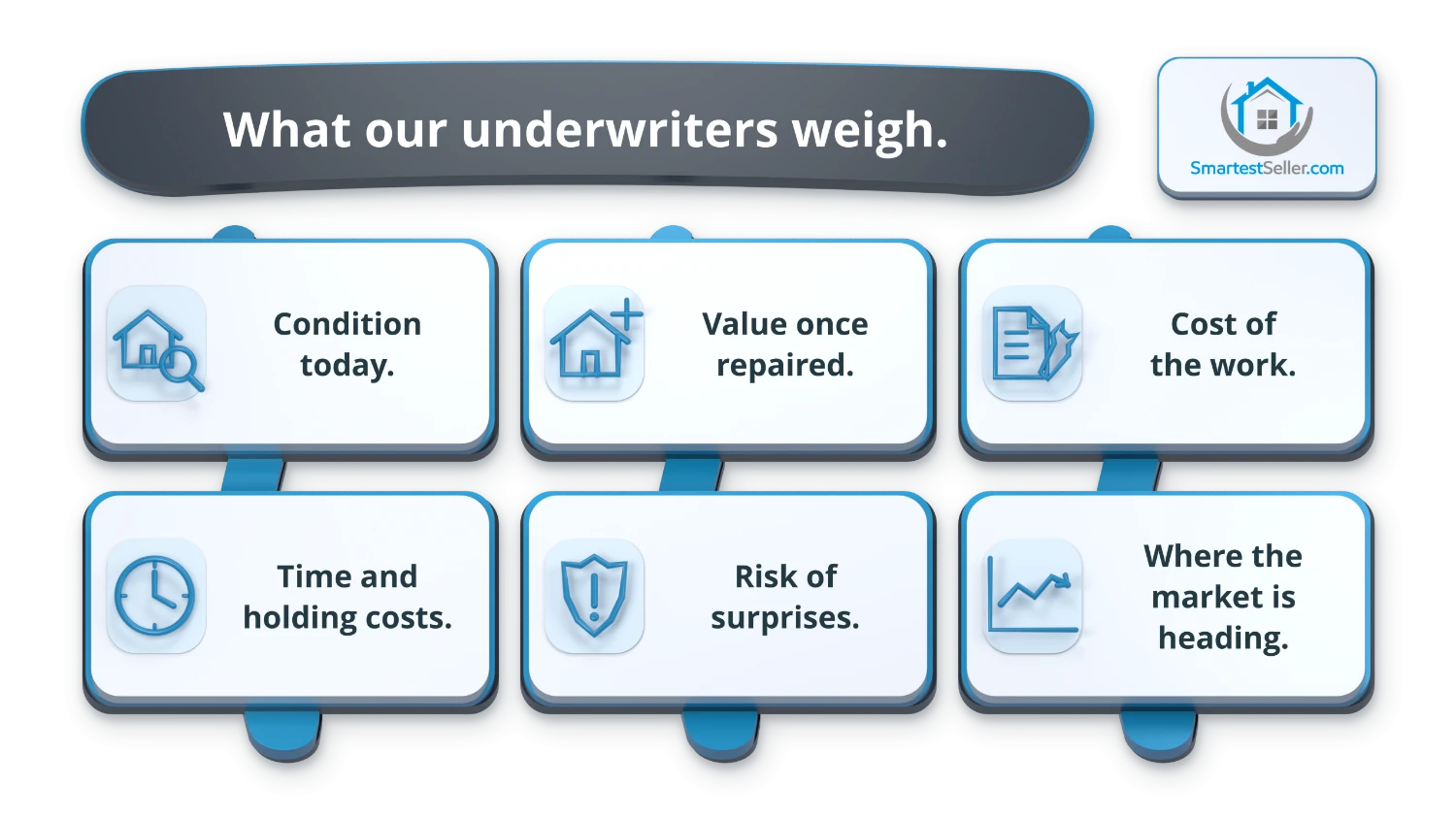
What Do Your Underwriters Actually Weigh?
The condition of the house today
Not a guess from photos. Roof age and remaining life, the air conditioning, plumbing and electrical, the foundation and any movement, moisture or pest damage, and the state of the kitchen, baths, flooring and windows. Also the things that only show up in person: smells that mean something, a slab that has shifted, wiring that an insurer will refuse.
What it would be worth once repaired
What a comparable house in that neighborhood, finished to the standard buyers there expect, actually sells for. Not the optimistic number, and not the Zestimate. This is where local knowledge matters most, because the finished standard in Arcadia is not the finished standard in Maryvale, and the gap between them is the whole business.
What the work will cost
Real contractor pricing for the actual scope, including the parts nobody budgets for: permits, dumpsters, utilities while the house sits empty, and the two or three things that turn up once the drywall comes off. Rehab budgets that assume nothing goes wrong are how buyers end up unable to close.
Time and holding costs
Every month the house is owned costs money: the capital tied up in it, insurance on a vacant property, taxes, utilities, security and landscaping. A four-week cosmetic refresh and a five-month structural project are very different propositions even at the same repair cost.
Risk
The honest name for what we do not yet know. Older homes carry more of it. So do houses that have sat empty, houses with permit history that does not match what is standing, and anything where access has been limited. Risk is why two bids on identical scopes differ.
Where the market is heading
A house bought today sells months from now. In a market drifting down, as much of the Valley has been, that drift is a real cost that has to be carried by somebody. We carry it, and that shows up in the number.
Why Is Your Offer Below What Zillow Says?
Because an automated estimate prices a hypothetical version of your house. It assumes average condition for the neighborhood, it cannot see your roof or your kitchen, and it has no idea about the water damage in the back bedroom. For a well-maintained home it is often roughly reasonable. For a house that needs work, it is describing a different property than the one you own.
What Would Make My Offer Higher?
Access, information, and certainty. Letting us see the whole property, including the parts you would rather not show, removes guesswork, and guesswork is priced conservatively. Permits and records for past work help. A clean title position helps. So does flexibility on timing. We have raised offers after a second look revealed the problem was smaller than it appeared, and after a seller cleared up a title question we had priced as a risk.
Is the First Number the Final Number?
Usually, but not always, and it can move either way. We do not open low intending to re-trade you later; that practice is common in this industry and we think it is contemptible. What can change the number is discovering something material that nobody knew about, in which case we explain exactly what we found and why it matters, and you are free to walk away.
What If I Think the Offer Is Too Low?
Say so, and ask us to walk you through it. Sometimes the explanation reveals we have mispriced something, and we correct it. Sometimes it reveals the house is simply worth more on the open market than to us, in which case listing is your better move and we will say so plainly. Our goal is to understand your goal and align with it. See all three options.
What Comes Out of the Offer at Closing?
Only what you already owe. There is no commission and we pay escrow, title, transfer and HOA transfer fees. Your mortgage payoff, any liens, and unpaid property taxes are settled from the proceeds through escrow, exactly as in any sale. You see an estimated net figure before you agree to anything. More on how liens clear at closing.
Common Questions
Do you charge anything for an offer?
No. There is no fee and no obligation, and you are not expected to pay for inspections or reports first.
How long does an offer take?
Usually within one business day of understanding the property.
Will you explain how you got to the number?
Yes, in detail, and we would rather you ask than wonder.
Do you make offers sight unseen?
We can give a preliminary range, but a real offer follows seeing the property, because condition is the biggest single variable.
See the Rest of the Process
How our process works | Compare your three options | Real Arizona transactions | Questions sellers ask
Want a Number and the Reasoning Behind It?
Tell us about the property below, or call or text (602) 428-9339. Know your selling options. Be the Smartest Seller.
Situations we handle: Foreclosure | Inherited property | Divorce | Rental with tenants | Fire or water damage | Tax liens and violations | Vacant property | Relocation
One More Step to Get Your Cash Offer…
Please tell us where to send your offer.