
Selling a California House With Tax Liens or Code Violations
California gives a residential owner five years from tax default before the county can sell the property at a tax sale. That is far longer than most people assume. But there is a route that shortens it to three, and a code violation is often what opens that route. Knowing which clock you are on changes what you should do next.
Last updated November 17, 2026 | Reviewed by Kyle Newman, Owner
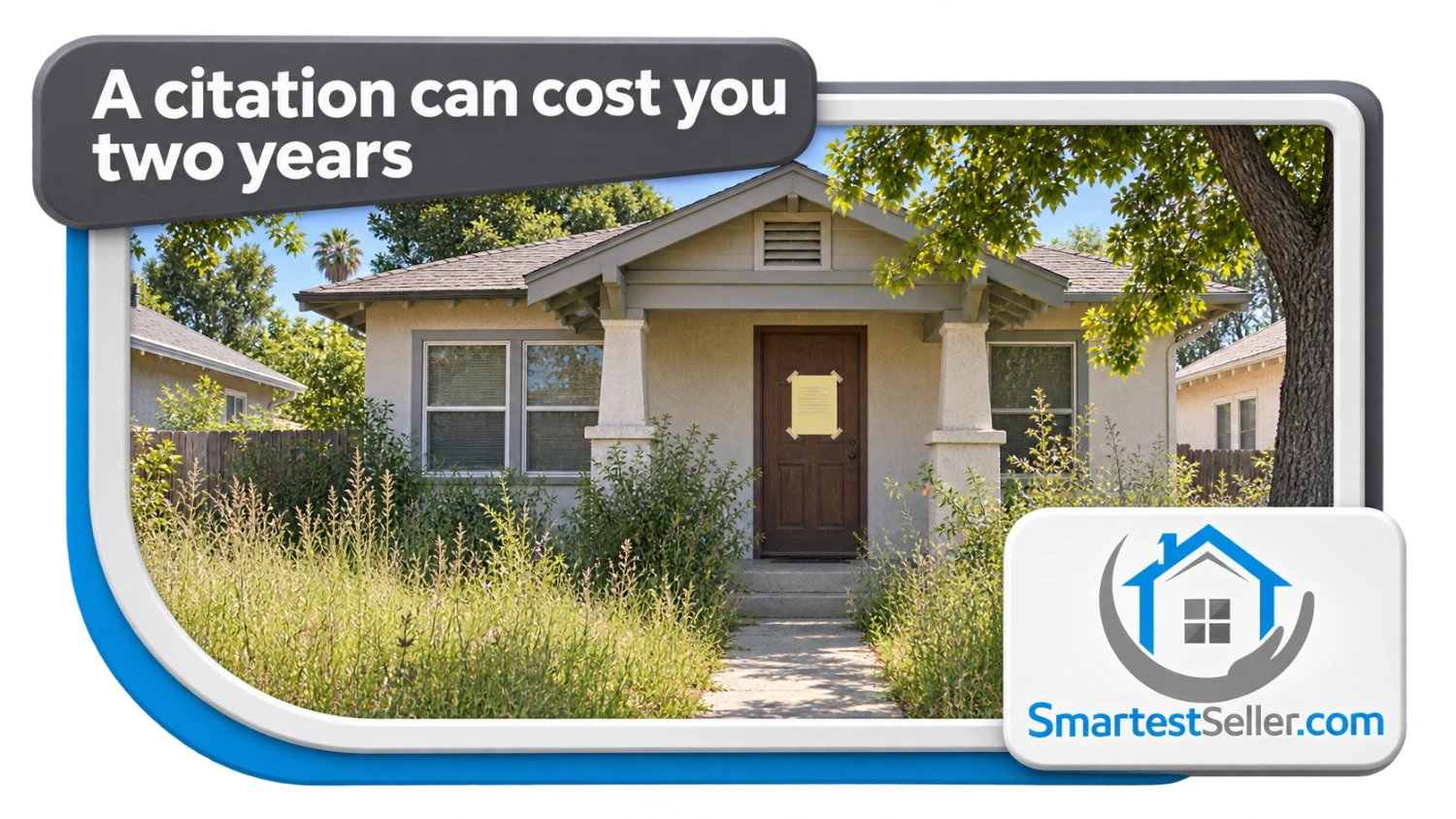
How long do I actually have before the county sells the house?
Five years from the date the property became tax defaulted, if it is residential. California Revenue and Taxation Code section 3691 is the statute. The tax collector may sell once five years or more have elapsed since default for residential property.
Three years if it is nonresidential commercial property. The statute defines nonresidential commercial property as everything except single family or multifamily units used or zoned as permanent residences, and real property used and zoned for commercial agricultural production. So a house is on the five year clock. A storefront is on three.
The clock pauses for disaster damage. Where the property was damaged in a declared disaster, the five year period is tolled until five years after the damage. If you are in a fire area, this may apply to you and is worth raising with your tax collector.
Default is not the same as missing one payment. Property becomes tax defaulted after unpaid taxes go unredeemed through the end of the fiscal year. Your county tax collector can tell you the exact default date on your parcel, and that date is the one the five years runs from, not the date you first fell behind.
Read the statute at California Revenue and Taxation Code section 3691.
What is the route that cuts five years down to three?
Subdivision (b) of the same statute, and almost nobody tells sellers about it. Three years after default, the tax collector may sell the property at the next scheduled tax sale if a city, a county, a nonprofit organization, or the holder of a nuisance abatement lien requests it.
Read that list again, because the last item is the one that catches people. A nuisance abatement lien is what a city records when it has cited a property, the owner has not fixed it, and the city has either abated the problem itself or run up enforcement costs. That lienholder can ask for an accelerated sale.
So the code violation is not just a fine. On a property that is also tax defaulted, an unresolved violation can shorten the window from five years to three. The two problems compound rather than sitting side by side.
If you have both, assume the shorter clock until your county tells you otherwise. Call the tax collector, ask for the default date, and ask whether any party has requested an accelerated sale on your parcel.
One more detail from the statute. Where vacant residential developed property is sold under subdivision (b), the owner must be sent certified mail notice if the owner can be identified. But the statute is explicit that the collector’s power of sale is not affected if the owner does not actually receive it. Mail you never got does not buy you time.
What happens to the liens when the house sells?
They get paid from the proceeds at closing, in priority order, and then they are gone. This is the part that relieves most people. You do not have to clear the liens before selling. Escrow handles it.
Property tax liens sit ahead of almost everything. They are paid first out of the sale proceeds, before the mortgage in most cases.
Code enforcement and abatement liens are recorded against the property too, which means a title search finds them and escrow pays them in order to deliver clear title. The amount is whatever the city’s payoff demand says, which is frequently more than the original citation once administrative costs and interest are added.
If the liens exceed the value of the house, that is a different conversation, and an honest one we will have with you. Sometimes the arithmetic does not work and no buyer can make it work. We would rather tell you that in the first conversation than after six weeks.
Do I need to fix the violations before I sell?
No, and in most cases you should not. A cited property sold as is transfers with the violations attached and the liens paid at closing. Spending money to cure a violation on a house you are selling anyway usually means paying twice.
The exception is a violation that blocks a transfer outright. A small number of enforcement actions, particularly those involving receivership or an order prohibiting occupancy, can complicate a sale. If you have received anything that reads like a court order rather than a citation, say so early.
Disclosure still applies. Known violations are material facts. You disclose them, the buyer prices them, and the sale proceeds. Hiding them is the only approach that reliably goes wrong.
Tax lien, tax deed, tax sale: which one am I dealing with?
The words get used interchangeably and they mean different things, which is why advice online is so often wrong for California.
California is a tax deed state, not a tax lien certificate state. In some states, counties sell investors a certificate representing the unpaid tax, and the investor collects interest or eventually forecloses. California does not do that for property taxes. The county holds the defaulted property and, after the statutory period, sells the property itself at a tax sale.
What that means for you is simple and mostly reassuring. There is no third party investor holding a certificate against your house and waiting you out. There is the county, a statutory period, and a sale at the end of it if nothing changes.
It also means advice written for Florida, Texas or Arizona may not apply. If you have been reading about redemption periods after a sale, be careful. California’s protection sits before the sale, in the statutory years you get to redeem, not after it.
What about IRS or state tax liens?
Completely different mechanism, frequently confused with property tax, and it does not put your house on the county’s sale calendar.
A federal tax lien arises from unpaid income tax and attaches to your property among everything else you own. A California Franchise Tax Board lien works similarly at the state level. Neither is a property tax lien and neither starts the clock in Revenue and Taxation Code section 3691.
They do affect a sale, because they get paid from proceeds. Escrow obtains a payoff and the lien is released at closing like any other recorded encumbrance.
There is a process where the equity will not cover it. The IRS has mechanisms for discharging a lien from a specific property or subordinating it, which can allow a sale to close where the arithmetic is tight. It takes time and paperwork, and it is a question for a tax professional rather than for us.
Tell us which kind you have. Owners say “tax lien” meaning either one, and the answer changes completely depending on which.
What are all of my options, including the ones that do not involve us?
Pay the taxes and redeem. Always the first option to consider. California allows redemption on an installment plan in many cases, which can stop the clock while you catch up. Your county tax collector administers it and it costs you nothing to ask.
Fix the violations and keep the house. If the citations are cosmetic or minor and you have the means, curing them removes both the lien risk and the accelerated sale route.
Refinance or borrow against the equity. If there is substantial equity and your credit supports it, a loan can clear the arrears. Harder on a cited property, but worth asking.
List it with an agent. A house with manageable liens and good condition often sells best on the open market, and the liens simply get paid at closing. When that is the right call we say so, and we can hand you to an agent who has dealt with lien payoffs before. That introduction earns us a referral fee.
A renovation backed retail sale. We put up the money for the work, clear the citations, handle the contractors, and only then take it to market. Right where the violations are the single obstacle between this house and an ordinary sale.
Sell it to us directly. As is, violations and all, with the liens paid out of the proceeds at closing. Fits where the clock is short, the repair bill is beyond reach, or you simply want it finished.
Know your options. Be the Smartest Seller.
Why do owners in this situation often end up selling?
Because the costs compound in a way that does not reverse on its own. Penalties and interest accrue on the tax side. Administrative costs accrue on the enforcement side. Neither stops because you are busy or because you intend to deal with it later.
And because the asset is usually not the problem. Most of these properties are perfectly sound houses owned by someone whose circumstances changed. The house did not fail. The owner ran out of capacity to maintain a thing that costs money every month.
There is no judgment in this from us. We have bought from people who inherited a house with eight years of deferred everything, from people who got sick, and from landlords whose tenant left the place cited and empty.
How do you decide what to offer?
Liens make this arithmetic different from an ordinary purchase, because they come off the top before anything else. Our underwriters price the house in its current state and in its repaired state, then subtract every recorded payoff demand, the trades, the carry and the market risk. On a heavily encumbered property the payoff figures move the number more than the condition does.
Get the payoff figures early if you can. A current tax bill and a city payoff demand let us be precise instead of conservative, and precise is usually better for you.
You will usually hear from us within one business day.
Common questions about California tax liens and code violations
Will the county really take my house?
It can, after the statutory period, and counties do hold tax sales. But five years for residential property is a long runway and most owners who act have options. The risk rises sharply if an accelerated sale has been requested.
Can I sell if I am already in default?
Yes. Selling before a tax sale is one of the most common ways people resolve this, and the taxes are paid from the proceeds.
Do I have to pay the liens before closing?
No. Escrow pays recorded liens out of the sale proceeds and delivers clear title to the buyer.
The city keeps sending citations and I cannot afford the repairs. What now?
Tell us what they say. Citations that have become liens affect the arithmetic but not whether a sale can happen, and an unresolved violation is also the thing that can shorten your tax timeline.
What if the liens are worth more than the house?
Then we will say so. Not every property can be sold profitably and we would rather be straight with you than waste your time.
One More Step to Get Your Cash Offer…
Please tell us where to send your offer.
Related California pages
Start with the California selling guide. City pages: Sacramento, Los Angeles, San Francisco, Oakland, San Diego, Riverside, Hemet, Fresno, San Bernardino. Other situations: foreclosure, an inherited house, divorce, a tenant occupied property, fire or water damage and a vacant or abandoned house. We also work throughout Arizona.