
Selling a Vacant or Abandoned House in California
A vacant California house is rarely just sitting there. If a Notice of Default has been recorded, city registration duties and inspection requirements can start within weeks, with penalties that accrue daily. And a standard homeowners policy often restricts or voids coverage once a property has been empty past a set period. Both clocks run whether or not anyone is paying attention.
Last updated November 17, 2026 | Reviewed by Kyle Newman, Owner
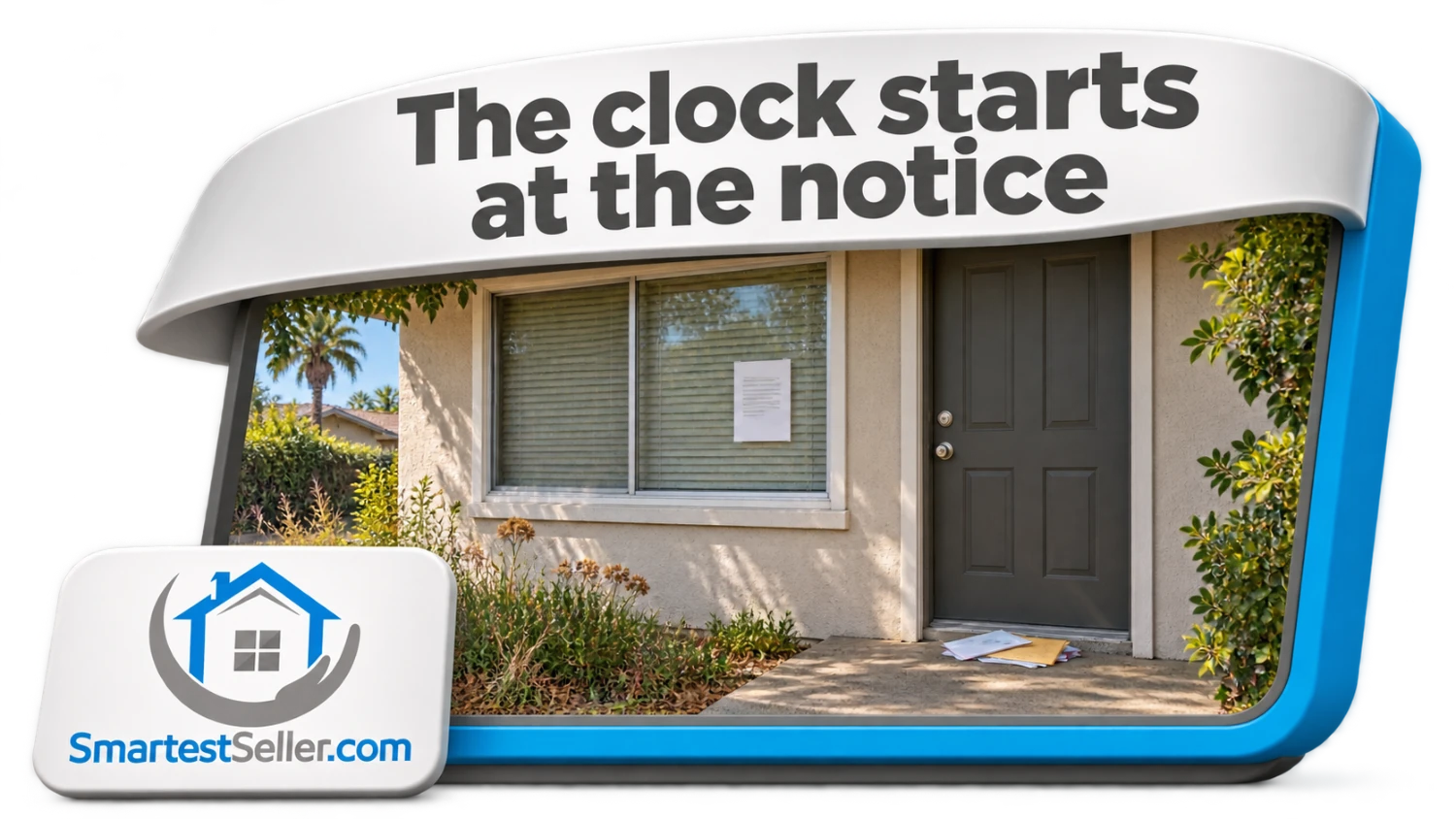
What starts happening once a house sits empty?
Three separate things, on three separate clocks, none of which announce themselves.
The insurance clock. Standard homeowners policies commonly restrict or suspend key coverage once a dwelling has been vacant beyond a stated period. The exact trigger is in your policy. The consequence is that the moment you most need coverage, a vandalism or water loss in an empty house, may be the moment you do not have it.
The city clock. California cities run vacant and defaulted property registration programs. Several of them start from the recorded Notice of Default rather than from the trustee sale, which is far earlier than owners expect.
The condition clock. Empty houses deteriorate faster than occupied ones. Nobody notices the slow leak, the roof lifting, or the back door that no longer latches.
Vacant or abandoned: is there a difference?
Yes, and it is not just wording.
Vacant usually means nobody lives there. You still own it, you may still be paying on it, and you may be maintaining it perfectly well. A second home, a house between tenants, an estate property waiting on probate. Vacant is a factual description, not a judgment.
Abandoned carries the extra sense that the owner has stopped engaging. No maintenance, no response to notices, often no payments. That is the condition most city programs are built to address, and it is where the enforcement escalates.
City programs frequently treat the two differently. Oakland’s program, for example, distinguishes vacant properties with a recorded Notice of Default from occupied ones, with different inspection frequencies and a fee that applies to the vacant category.
The reason it matters to you is that the label drives the cost. A property that reads as abandoned to a code officer attracts attention a maintained vacant property does not. Mowing the grass and securing the doors is cheap compared with what follows if nobody does.
What do California cities actually require?
Registration, inspection, maintenance and reporting, with real penalties. Oakland’s program is a well documented example and is worth reading even if your house is elsewhere, because the structure is typical.
Under Oakland’s program for foreclosed and defaulted residential properties, an owner must:
- Inspect the property within 30 days of the Notice of Default being recorded
- Register within 30 days of that inspection, and no later than 60 days after the NOD
- Inspect a vacant NOD property monthly, and a vacant foreclosed property weekly
- Record findings in the city registry every 30 days and certify monthly that inspections happened
- Secure access points and post 24 hour contact information
- Update the registry within 30 days of any status change, and deregister within 30 days after the default is cured or the property sells
- Use a licensed local property manager if the owner is out of area
The enforcement is not nominal. There is an annual registration fee for vacant properties, a citation for failing to register on time, and a separate per day penalty for failing to inspect and maintain certain properties. Per day is the part that compounds.
Other California cities run their own versions with different triggers and different fees. Your city’s code enforcement or building department is the place to confirm what applies to your address. Do not assume there is nothing, because the default assumption is usually wrong. Our Oakland page covers that market specifically.
Why does the Notice of Default matter so much here?
Because it is the trigger, and most owners think the trigger is the trustee sale. An owner who has stopped paying and moved out often believes the house is dormant until the foreclosure concludes. In a city with a program like Oakland’s, obligations started within 30 days of the NOD recording and have been accruing since.
That means the quiet period people imagine does not exist. The foreclosure timeline and the vacant property timeline run in parallel. Our California foreclosure page covers the first one.
It also means the bill can be substantial by the time anyone looks. Months of unregistered status plus months of unperformed inspections, on a per day basis, is not a small number.
What about squatters?
Removing someone from a property in California is an eviction, and it has to go through the courts. Even where the occupant has no lease and never had permission, self help is not available. You cannot change the locks, remove belongings or cut utilities.
The process is an unlawful detainer action. It takes time, it costs money, and it runs on the court’s schedule rather than yours. If someone is in your vacant house, start with a lawyer rather than with a locksmith.
We buy occupied property, including property with unauthorised occupants. It affects price because it affects what the buyer has to do. It does not stop a sale.
What about the tax side?
A vacant house still generates property tax, and a tax defaulted vacant house has a specific exposure. Where vacant residential developed property is sold under the accelerated route in California’s tax sale statute, the owner must be sent certified mail notice where identifiable, but the collector’s power of sale is not affected if the owner does not receive it.
Mail forwarded from a house nobody lives in is mail that frequently does not arrive. That is the practical risk of a vacant property with tax arrears: the notices go to an address you left. Our tax liens and code violations page sets out the timeline in full.
What if I inherited it and it has sat empty since?
This is one of the most common versions we see, and the two problems compound.
Probate takes months and the house does not pause for it. Meanwhile the insurance vacancy clock runs, the city clock may be running, and the condition clock certainly is. Families frequently discover that a year of nothing happening cost more than anyone expected.
You may be able to sell during probate rather than after it. California’s Independent Administration of Estates Act allows a representative with full authority to sell by Notice of Proposed Action in many cases, without a court hearing. Our inherited house page sets out how that works and what limited authority changes.
Insure it as what it is. An inherited empty house is a vacant property to an insurer, and the policy that covered it while your relative lived there may not cover it now. A vacancy endorsement or a dedicated vacant property policy costs money, and it costs a great deal less than an uninsured loss.
Secure it early even if you cannot deal with it yet. The single most expensive thing that happens to inherited empty houses is the one nobody is there to notice for six months.
What are all of my options, including the ones that do not involve us?
Move back in or rent it out. Occupancy solves the insurance problem, the registration problem in most programs, and the deterioration problem at once. If the house is habitable and you have the appetite to be a landlord, this is worth considering first.
Register and maintain it properly. If you intend to hold, comply. The fees are far cheaper than the penalties, and compliance stops the daily accrual.
Repair and list it with an agent. A vacant house in sound condition sells perfectly well on the open market. Vacancy is not a defect. Where that applies we say so, and we can connect you with an agent. We earn a referral fee on the introduction.
A renovation backed retail sale. We cover the cost of bringing it back, run the project ourselves, and list it when it is ready. Suited to a house that has been shut long enough to need real work before anyone would walk through it.
Sell it to us directly. As is, contents and all, with whatever the city has recorded against it paid out of proceeds at closing. Fits an owner who is out of area, out of capacity, or simply done.
Know your options. Be the Smartest Seller.
Do I need to clean it out or secure it first?
No on the contents. Yes, please, on basic security if you safely can. Leave whatever you do not want. We handle clear outs routinely and it does not change our number much.
Securing it is different, because an open house invites the problems that genuinely do reduce value: copper theft, water left running, fire. If you can lock it and board an open window, do. If you cannot get there, tell us and we will work with what is there.
How do you decide what to offer?
Two things drive the number on an empty house: what it needs, and how confidently anyone can know what it needs. Our underwriters weigh the current state against the finished state, the months of carry, whatever the city and the county have recorded, and who might still be inside. A house standing open for years hides more than a house empty since spring.
Getting us inside helps your number more than almost anything else. Pricing an inaccessible vacant house means pricing the worst plausible case.
You will usually hear from us within one business day.
Common questions about selling a vacant house in California
How long can a house sit empty before my insurance stops covering it?
That is in your policy and the period varies by carrier. Call your agent and ask specifically about the vacancy provision, because many owners assume they are covered when they are not.
I live out of state. Can I sell without flying out?
Yes. California sales close through escrow and remote notarisation and mail away closings are routine. Several cities do require out of area owners to appoint a local property manager while the house sits, which is a separate obligation.
There are squatters in the house. Will you still buy it?
Yes. It affects price because it affects what we take on. Do not try to remove anyone yourself.
The city has been sending notices. Does that stop a sale?
No. Recorded liens are paid from proceeds at closing. Unregistered status and accrued penalties are figures to establish, not barriers.
The house has been empty for years and is in bad shape. Is it worth anything?
Usually yes, because the land carries value. We buy houses that need everything.
One More Step to Get Your Cash Offer…
Please tell us where to send your offer.
Related California pages
Start with the California selling guide. City pages: Sacramento, Los Angeles, San Francisco, Oakland, San Diego, Riverside, Hemet, Fresno, San Bernardino. Other situations: foreclosure, an inherited house, divorce, a tenant occupied property, tax liens and code violations and fire or water damage. We also work throughout Arizona.