
Selling a Manufactured Home on Land You Own in California
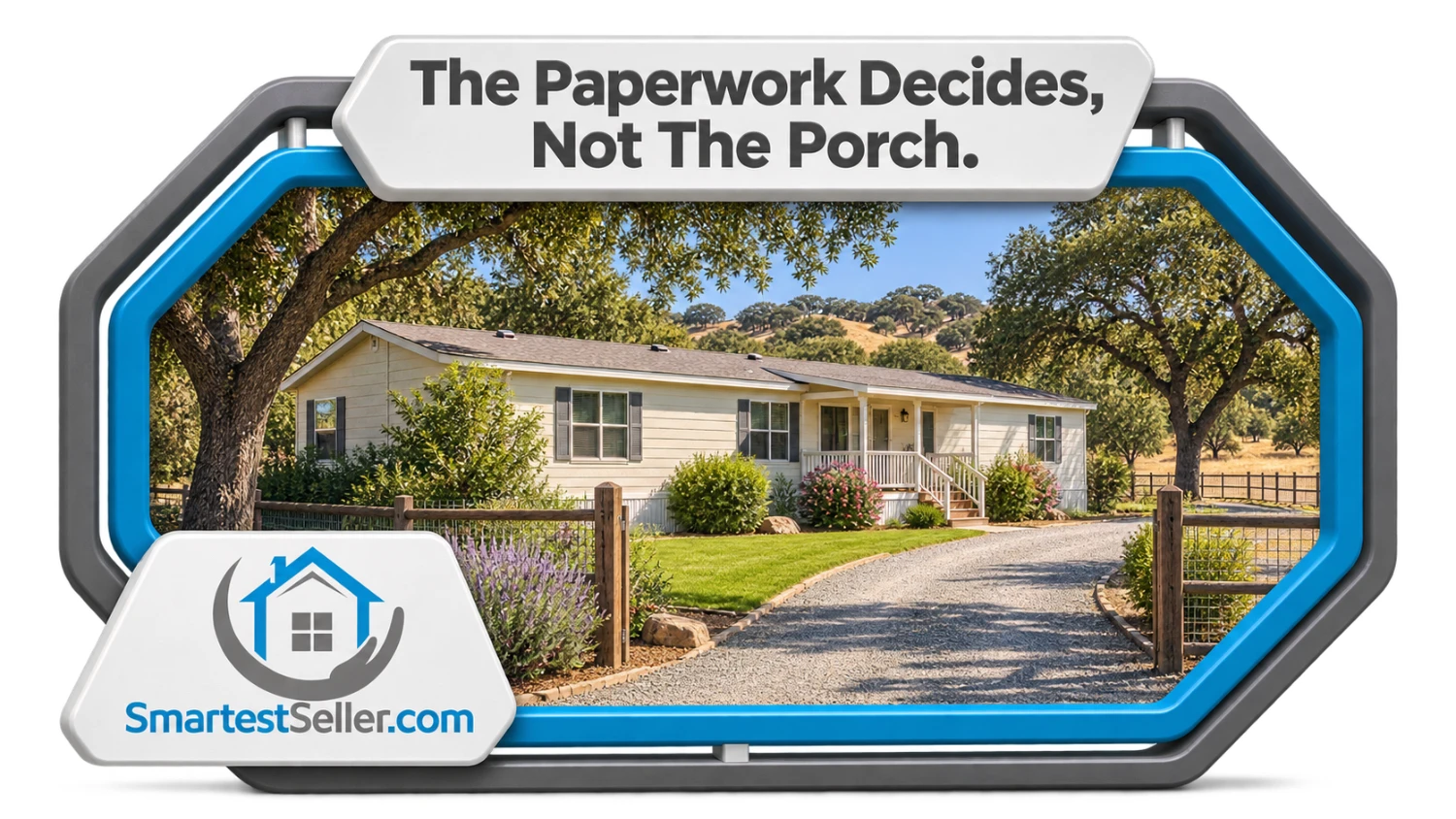
We buy manufactured and mobile homes in California only where you own the land underneath. Before anything else, find out whether your home is legally real property or still personal property, because that single fact decides how it transfers, who can lend on it, and what a buyer can pay. Appearance does not decide it. A recorded document does.
Last updated November 17, 2026 | Reviewed by Kyle Newman, Owner
One More Step to Get Your Cash Offer…
Please tell us where to send your offer.
Do you buy manufactured homes on rented lots or in parks?
No. We buy only where the seller owns the land. If your home sits on a rented space in a community, a park, or on someone else’s property under a lot agreement, we are not the right buyer and we will tell you so on the first call rather than waste your week.
That sale is a different transaction with different parties. It usually runs through a dealer who specializes in community homes, and the community office has a say in who the next resident is. Start with the community manager and with dealers who work inside parks. We would rather point you there immediately than string you along.
Everything below assumes the land is yours. Owned lot, owned acreage, owned parcel, however it is described on your deed.
Is your manufactured home real property or personal property in California?
It is personal property until a specific legal process converts it, no matter how permanent it looks. This is the part that catches sellers off guard, and it is worth being blunt about.
California’s assessment guidance is direct on the point. The State Board of Equalization’s Assessors’ Handbook 511 explains that where the certificate of occupancy and the recorded document are absent, the home has not been affixed and is not considered real property.
So a home can look entirely permanent and still be personal property on paper. Skirting all the way around, a poured pad under it, a porch and a carport built on, thirty years of mature landscaping, and the county still has it on a different roll than the dirt it sits on.
Why it matters to your sale. Real property transfers with a deed and can be financed like any other house. Personal property transfers through a title record held by the Department of Housing and Community Development, and the pool of buyers who can finance it is far smaller. Two homes side by side, identical to look at, can be worth noticeably different numbers because of which category they fall in.
How to find out. Look at your property tax bill, your title or registration paperwork, and your county recorder’s index. If you have a recorded conversion document in your name, you are real property. If you have a title or registration card, you probably are not.
How does a California manufactured home become real property?
Through a permit and inspection run by your local enforcement agency, ending in a recorded form 433A. California does not let the owner do this alone with a form and a notary. A government inspection is part of it.
The sequence, according to HCD’s own foundation system flowchart:
- The owner gives the local enforcement agency written evidence of owning the land, the installation plans or instructions, permit fees, and a per-section fee payable to HCD
- The agency requires written evidence that the home is free of liens, or that the lien holders agree to the home attaching to the real property
- For a used home, any title or registration card is surrendered to the agency
- The agency inspects, issues a Certificate of Occupancy, and records the 433A with the county recorder
- The agency sends the recorded document, the fee and the titling paperwork to HCD
- HCD cancels its permanent title record and the status becomes a permanent foundation under the statute
- The county recorder indexes the recorded form to the named homeowner
Read that list for the two parts you do not control. One is the inspection, which runs on your county’s calendar, not yours. The other is the lien holder, who has to cooperate in writing. Neither is a weekend project, and both are reasons to find out your status early rather than in escrow.
The authority is Health and Safety Code section 18551, which is why you will see conversions referred to by that section number on county records and in title reports.
What if the home was never converted?
Then you sell two things in one transaction, and both have to work. A deed moves the land. A separate transfer through HCD moves the home. They are different systems with different paperwork and different timing.
This is doable and we do it. It is not a reason the sale fails. It is a reason to know in advance, because a seller who believes the whole thing moves by deed will be surprised twice: once by the extra paperwork and once by the valuation.
You do not have to convert it before selling to us. Converting takes a county inspection and lien holder cooperation, and if you are selling because you need the matter resolved quickly, adding a permit process is the opposite of helpful. We buy it as it sits, in whichever category it is in.
If you are listing on the open market instead, converting first may be worth the delay. It widens the buyer pool to anyone who can get an ordinary mortgage. Whether that is worth a few months depends on your timeline, and that is a conversation to have with an agent who has sold manufactured homes in your county before.
Which tax system is your home on?
California runs two parallel systems and your home is in one of them. There is a vehicle license fee administered by HCD, and there is local property tax administered by your county assessor.
The dividing line is the date the home was first sold new. Handbook 511 explains that homes sold new on or after July 1, 1980 went onto the local property tax roll, and homes sold new before that date stayed on the license fee system unless something moved them.
The part that matters at closing: a used home keeps whichever system applied before the sale. Selling the home does not switch it. Your buyer inherits your system, which is why a buyer or a title officer will ask, and why you should know the answer before they do.
An owner on the older license fee system can choose to move the home onto the property tax roll voluntarily. That is an owner’s election, not something that happens automatically.
Once a home sits on an approved permanent foundation, the handbook says it is taxed in the same manner as conventional housing. At that point the two-system question disappears and it is simply a house.
What does a lien holder have to do with any of this?
A security interest recorded against the home follows the home, and it does not vanish because the home became part of the land. This is the same trap sellers fall into in other states, and it is worth stating plainly.
The conversion process builds the lien question in on purpose. The enforcement agency wants written evidence that the home is free of liens, or written agreement from the lien holders, before it will record the conversion.
If you financed the home separately from the land, there may be two payoffs at closing, one against the land and one against the home. Title finds both. Knowing about the second one in advance keeps it from becoming a surprise deduction from your proceeds.
What about homes built before the federal construction standard?
A home built before June 15, 1976 was not built to the federal manufactured housing construction and safety standard, and most lenders will not finance one. That is a lending reality rather than a judgment about the home, and many pre-standard homes are sound and well kept.
The practical effect on your sale is the buyer pool. Without financing available, your realistic buyers are cash buyers. That is one of the clearest cases where a direct sale is not just faster but close to the only route that completes.
Age alone does not stop us. We look at the land, the condition of the home, and what the parcel supports. A pre-standard home on an acre you own is a transaction we can do.
How does an as-is sale work here?
You do nothing to the home. No repairs, no skirting replaced, no roof coating, no hauling off what is in the shed. We account for condition when we price it.
We look at the land and the home as one package. On owned land, the parcel often carries more of the value than the structure does. Acreage, usable space, utilities already run, and what the zoning permits all matter, sometimes more than the home’s year or condition.
An offer comes usually within one business day of seeing the property, in person or by photos.
We close at the pace the title company can accommodate and you actually need. If the title record on the home has to be untangled first, that is part of the work and we expect it.
What else could you do instead?
List it with an agent who has sold manufactured homes in your county. This is a specialty. An agent who has never handled a 433A question will learn it on your transaction. If the home is converted, in good shape, and on desirable land, listing it will usually bring the best number.
Sell it yourself to a neighbor or a family member. On owned land this happens more often than people expect, particularly on rural parcels. Use a title company anyway, so the land and the home both transfer correctly.
Keep it and rent it. On owned land in much of California this pencils better than people assume. It also makes you a landlord, which our tenant occupied page covers in detail.
Sell to us. As is, no repairs, no showings, no commission, and a closing date you pick. The trade is price for certainty, and we will say so plainly rather than pretend otherwise.
Common questions
Do you buy manufactured homes on leased or rented land in California?
No. We buy only where you own the land. For a home on a rented space, start with the community office and with dealers who work inside parks.
Does the home have to be converted to real property before I sell?
No. We buy either way. Conversion requires a county inspection and lien holder cooperation, and if speed is the reason you are selling, adding that process works against you.
How do I find out whether my home is real property?
Check your property tax bill, look for a title or registration card, and check your county recorder’s index for a recorded conversion in your name. A title company can confirm it quickly.
Does an older home disqualify it?
No. Homes built before the 1976 federal standard are hard to finance, which narrows the buyer pool, but it does not stop a cash purchase.
What if I inherited the home and the title is still in a parent’s name?
That is common and it is solvable. The authority to sign comes first, and our inherited house page covers how that is established.
Related California pages
Statewide process: the California selling guide. The Arizona equivalent, which runs on a different mechanism, is Arizona manufactured homes on owned land. Other property types: duplexes, triplexes and fourplexes, apartment buildings of five units and up. Situations: an inherited house, a tenant occupied rental, a vacant house, relocation, foreclosure, tax liens and code violations, fire or water damage. Cities: Fresno, Riverside, San Bernardino, Hemet, Sacramento, Los Angeles, San Diego, Oakland, San Francisco.